Why Small Talk Feels Hard in English
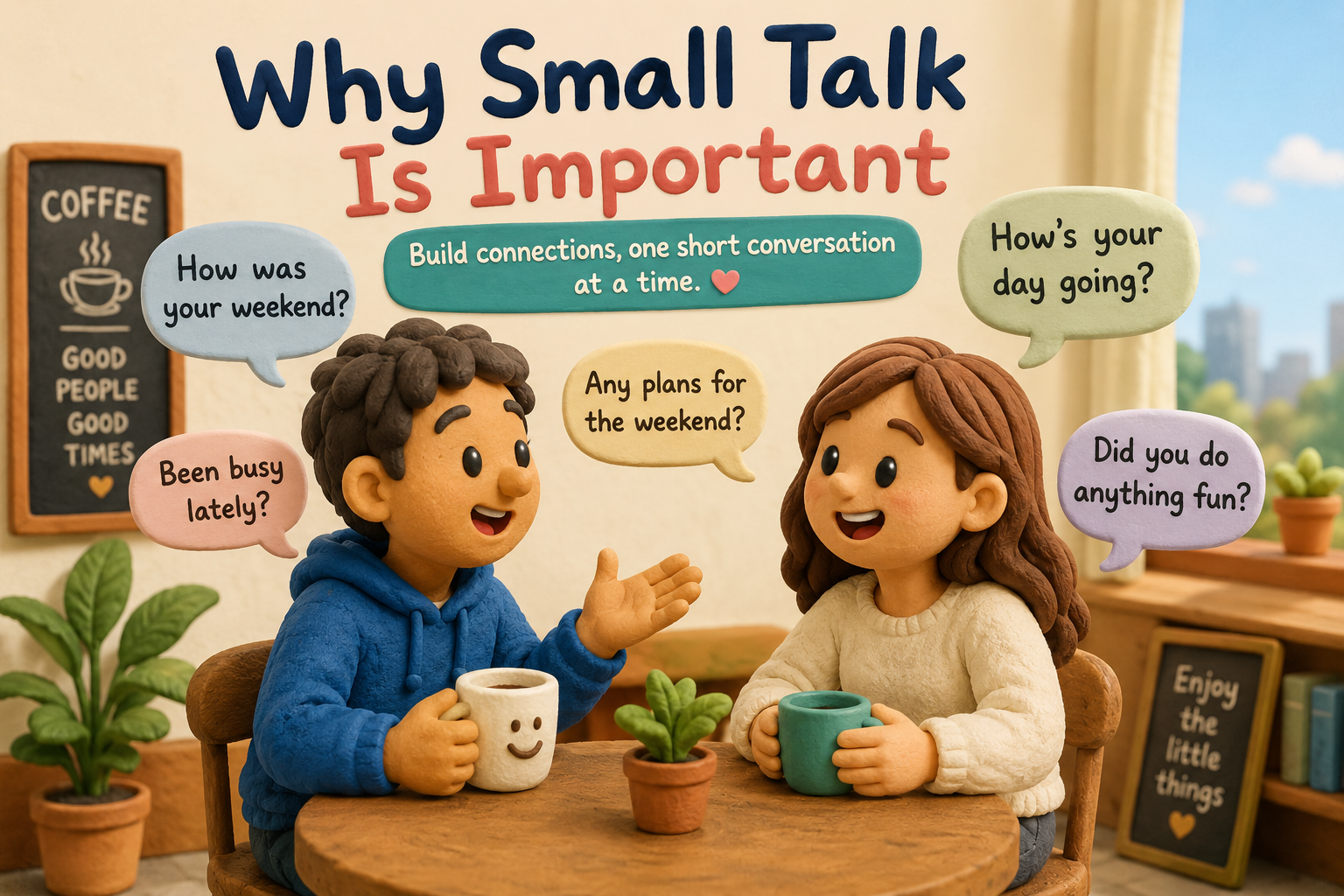
Why Do English Speakers Ask So Many "Unimportant" Questions?
If you're learning English, you may have wondered:
"Why do people ask questions like these so often?"
- "How's your day going?"
- "Been busy lately?"
- "Any plans for the weekend?"
At first, these questions can seem a little strange. You might wonder, "Do they really want to know?" Surprisingly, not always.
In many English-speaking cultures, people often use small talk to create a social connection rather than gather important information. The goal is usually to make the other person feel comfortable, avoid awkward silence, and slowly build a friendly atmosphere.
In other words, people are often communicating something like:
- "I'm friendly."
- "I'm open to talking."
- "Let's get comfortable first."
This can sometimes feel strange for learners from other cultures. In Korea and some other countries, conversations can become more practical or personal earlier because asking questions helps people understand relationships and social connections.
For example, questions about age, work, university and family background can sometimes feel more natural early in a conversation.
In many English-speaking cultures, however, people often start with lighter topics first:
- Weekend plans
- Hobbies
- Food
- Weather
- Daily life
Neither approach is right or wrong. They simply have different goals. One often focuses more on understanding a person's situation and relationship to others, while the other often focuses on creating comfort before moving into deeper conversations.
1. Small Talk Usually Isn't Taught in School
Many students spend years learning English at school. They become very good at grammar, reading and understanding English. However, when someone asks a simple question like "How was your weekend?" suddenly things feel much harder.
They learn how to answer questions such as:
- "What is your favourite subject?"
- "Describe your hometown."
However, real conversations are often much less structured.
Instead of asking:
"What are your hobbies?"
People may say:
- "So, what do you usually do for fun?"
- "Have you been watching anything interesting lately?"
- "Did you do anything fun this weekend?"
The problem is not usually English itself. Many students simply have not had much practice with everyday conversations because this type of English is not taught very often in school.
2. Small Talk Is Usually Less Serious Than You Think
Many English learners feel pressure during small talk because they think they need to give interesting answers or say something impressive.
They often think:
- "Should I say something exciting?"
- "What if my English sounds strange?"
- "What if my answer is boring?"
In reality, small talk is often much more relaxed than that.
Simple answers are completely normal:
- "Pretty relaxing. I mostly stayed home."
- "Nothing exciting. I just rested."
- "Not bad. I met a friend for dinner."
Most people are not expecting a perfect or exciting answer. Often, they simply want a comfortable conversation and to slowly get to know you better.
Remember, the goal of small talk is not to impress someone. It is simply to keep the conversation moving and build a connection.
3. But Why Small Talk Matters More Than You Think
Although small talk is usually casual and relaxed, it can be surprisingly important, especially in professional situations.
In business and more formal environments, people often do not jump directly into meetings or serious discussions. Small talk helps create a comfortable atmosphere before moving into work-related topics.
For example, before a meeting someone might ask:
- "How has your week been?"
- "Did you do anything interesting over the weekend?"
- "How are things going at work?"
These questions are usually not asked because the person needs detailed information. Instead, they help build trust, reduce tension, and create a more natural relationship.
Imagine walking into a meeting and immediately saying, "Let's discuss sales numbers."
Compared to, "Good morning. How has your week been so far?"
The second example often feels warmer and more natural.
Over time, if you know someone better, remembering small personal details can also help strengthen professional relationships.
For example:
- "How was your son's football game?"
- "Did your family enjoy the trip you mentioned?"
- "How did your daughter's exam go?"
People often appreciate when others remember something they previously shared because it shows interest and attention, rather than simply making conversation.
Of course, this usually happens after building some familiarity and comfort. Small talk is not about asking very personal questions immediately, but about gradually building a natural connection.
4. Learn Conversation Patterns Instead of Memorising Scripts
Many learners try to memorise complete answers. The problem is that conversations rarely follow a script.
Instead, use a simple pattern:
Question → Short answer → Extra detail → Return question
Example:
Person A: "How was your weekend?"
Person B: "Pretty good. I went hiking with some friends. The weather was great. How about you?"
Notice that the answer is not long or complicated. It simply gives a little more information and keeps the conversation moving.
5. Small Talk Does Not Need to Stay on One Topic
Many English learners think they need to continue talking about the same topic for several minutes.
In reality, conversations often move naturally from one topic to another.
For example:
Person A: "How was your weekend?"
Person B: "It was good. I went hiking with some friends."
Person A: "That sounds nice. The weather has been great lately, hasn't it?"
The conversation started with the weekend but naturally moved to the weather.
Another example:
Person A: "Been busy lately?"
Person B: "Yeah, work has been pretty hectic recently."
Person A: "Speaking of work, do you work from home or go into the office?"
Think of small talk as stepping stones rather than a straight road. One topic often leads naturally to another.
As conversations move naturally from one topic to another, they also often become more meaningful over time. Small talk usually acts as a bridge rather than a completely separate type of conversation.
6. Practical Ways to Become Better at Small Talk
Small talk becomes easier with practice, and you do not need to make huge changes.
Try these:
- Ask one follow-up question
- Add one extra sentence to your answer
- Learn one useful phrase every day
- Practice talking about your weekend, hobbies, or daily routine
- Focus on communication rather than perfect grammar
If you would like a simple formula for adding that extra sentence, see our guide on how to keep an English conversation going.
Small improvements build confidence over time. Regular conversational English lessons are one of the best ways to practice these patterns with a real person.
Conclusion
Small talk can feel strange because different cultures often use conversations in different ways.
However, speaking naturally does not mean knowing every word or having perfect grammar.
Sometimes becoming better at English starts with something much simpler:
A short conversation about your day. I encourage you to try it with your English tutor or foreign friend!