Why People Are Afraid to Speak English
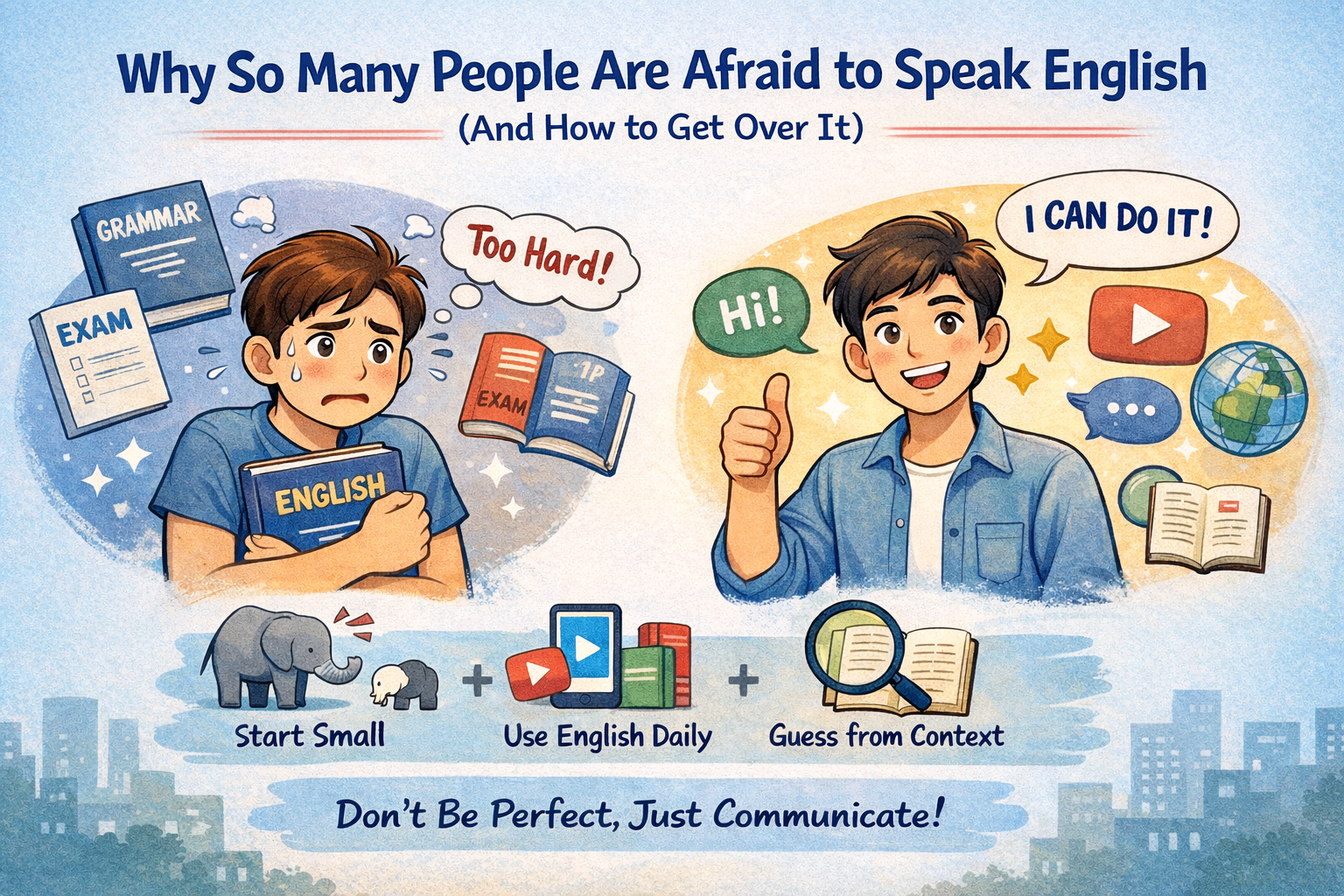
A lot of people are honestly just scared of English. (or learning a new language in general)
And it's not because they're lazy or not trying. A big reason is how English is taught and tested in school. The focus is often on difficult reading, tricky grammar, and vocabulary that doesn't feel like real, everyday English.
So, people start thinking, "English is too hard" or "I'll never be able to speak properly."
Then confidence drops. And once confidence goes, speaking becomes even harder.
In some countries, like Korea, this pressure is even stronger because of major exams like the CSAT. Students get used to studying for tests, not actually using English in conversation.
On top of that, there's this idea that you need to be perfect before you talk to a foreigner.
That's probably the biggest mistake.
1. No One Cares If Your English Is Perfect
Seriously, no one cares.
People don't expect perfect grammar or perfect sentences. What they actually care about is whether they can understand you and whether you're trying.
You can say something like:
"I go store yesterday, buy food, very good."
It's not perfect, but it works.
Communication is the goal. Not perfection.
If anything, most people respect you more for trying.
2. Start Small
There's that saying, how do you eat an elephant? One bite at a time.
Same thing with English.
You don't need to suddenly speak in full, perfect paragraphs. Just start with one sentence, one phrase, even one word!
Every time you speak, you improve a little bit. It might not feel like much, but it adds up.
Once you get over that first bit of fear, find a teacher or a class, or even just someone to practice with regularly — regular conversational English lessons are one of the fastest ways to build confidence. That's when things really start moving.
3. Use English in Everyday Life
You don't need a classroom to improve.
Start using English in small ways during your day:
- read billboards and try translating them in your head
- watch English YouTube or Netflix
- read simple posts or comments
- even reply to people online in basic English
I find that patterns in English really help to improve your vocabulary and understanding. Start looking for them and you will see them everywhere.
Like:
- mother, maternal, maternity
- act, action, active, activity
- nation, national, international
- help, helpful, helpless
You'll also start seeing how prefixes and suffixes change meaning.
For example, a small change at the beginning of a word can completely flip its meaning:
- happy → unhappy (un = not)
- fair → unfair
- kind → unkind
Or:
- possible → impossible (im = not)
- polite → impolite
- patient → impatient
And:
- agree → disagree (dis = opposite)
- like → dislike
- connect → disconnect
You'll also notice patterns with words like:
- view → preview (before) / review (again)
- test → pretest / retest
- write → rewrite
Once you see these patterns, learning new words becomes a lot easier. It's not just random vocabulary anymore, it starts to make sense.
4. Guess the Meaning from Context
There are thousands of idioms, phrasal verbs, and expressions in English.
You're not going to memorize all of them. No one does.
Instead, look at the whole sentence and try guess the meaning.
For example:
"I was feeling under the weather, so I stayed home."
Even if you don't know that phrase, you can guess the person wasn't feeling well.
That's a huge skill. And it gets better with time.
5. Don't Get Stuck on Grammar
Grammar is important, but it shouldn't stop you from speaking.
If you wait until your grammar is perfect, you'll never start.
The funny thing is that your grammar actually improves by speaking. You start to notice patterns naturally:
- "I have been…"
- "I'm going to…"
- "I used to…"
You hear it, you use it, and slowly it becomes natural.
6. Give It Time
Learning a language takes time. There's no shortcut.
Some days you'll feel like you're improving. Other days it feels like nothing is happening.
That's normal.
But every small step counts:
- a new word
- a sentence you understood
- a conversation you tried
Even things like social media can help if you pay attention to what you're reading.
7. Have a Goal
At some point, you need to ask yourself why you're learning English.
Do you want to watch movies without subtitles, talk to friends while gaming, travel and feel comfortable speaking, prepare for a job interview, or pass a test like IELTS or TOEIC? If it's the last two, targeted English interview coaching or focused test preparation will get you there much faster than general study.
Having a clear goal makes everything easier. It gives you a reason to keep going.
Final Thought
You don't need to be perfect to start speaking.
You just need to start. Let go of the idea that the only way I can speak to an English teacher or person is to first be perfect. That is not a possible scenario. Have patience with the process of learning a new language and keep trying.
Once you let go of this idea of being perfect from the start and just start using English, things slowly fall into place. You notice patterns, your confidence grows, and English starts feeling more natural.
And eventually, you realise it was never as impossible as it first felt.