How to Choose an Online English Tutor
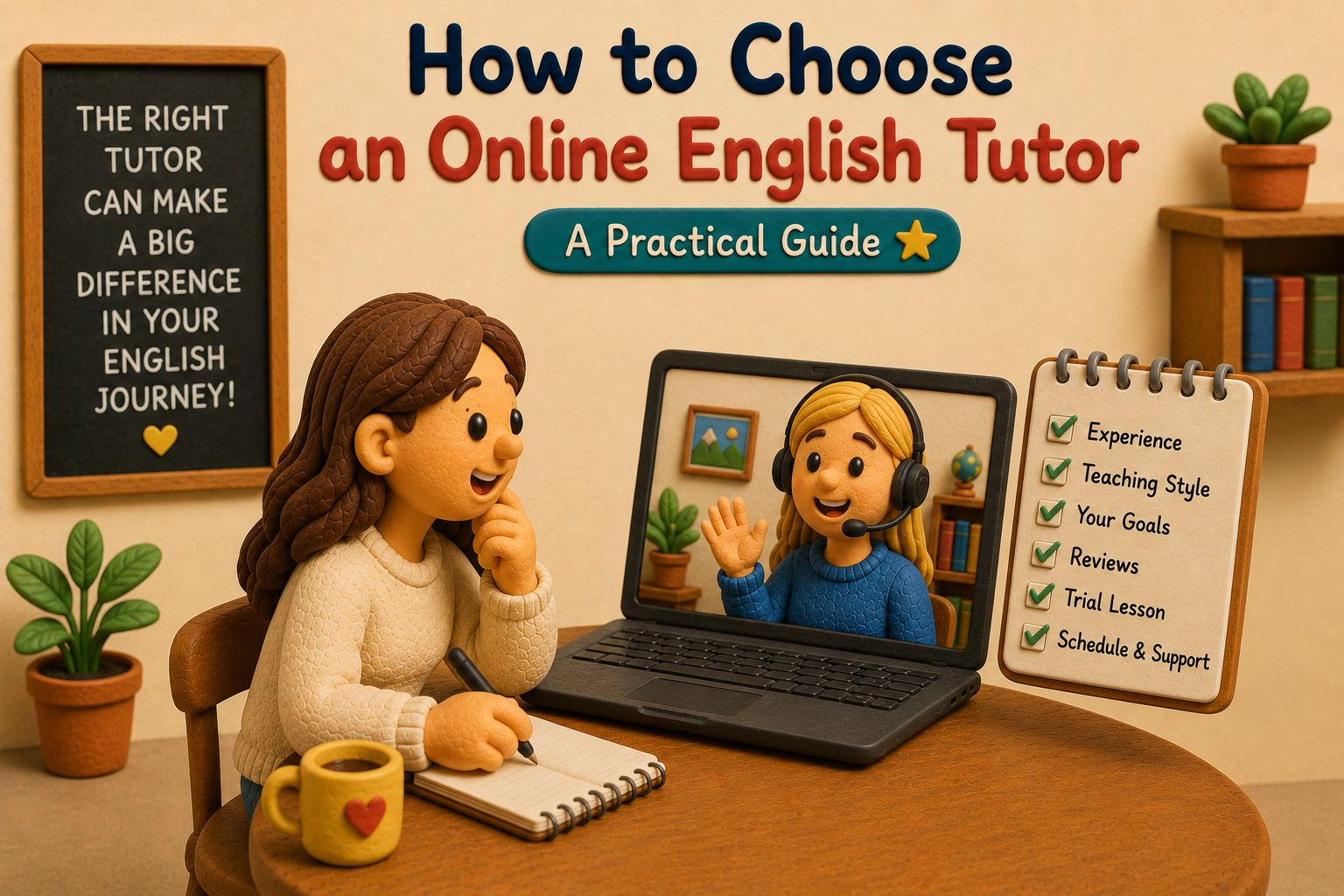
Searching for an online English tutor can feel overwhelming. There are huge marketplaces with thousands of teachers, freelance tutors with their own sites, language schools, and AI apps, all promising to help you "speak English fluently." So how do you actually pick one that fits?
After years of teaching adult learners online, here's the honest checklist I'd give a friend. It's the same framework I'd use myself if I was learning a new language tomorrow.
1. Get clear on your goal first (before you look at any tutor)
The single biggest reason people waste money on the wrong tutor is starting the search before they know what they actually want. "I want to improve my English" is too vague. Try to land somewhere closer to one of these:
- I want to feel comfortable in everyday conversation
- I want to pass IELTS / TOEIC / OPIc with a specific score
- I have a job interview in English in 6 weeks
- I need business English for meetings and emails
- I want to use English at university (lectures, presentations, papers)
A good conversational English tutor is not the same person as a good IELTS coach. Match the tutor to the goal, not the other way around.
2. Native speaker vs. non-native speaker: what actually matters
This debate gets more heated than it should be. The honest answer:
- Non-native tutors often explain grammar better, can speak your language, and are usually cheaper. Great for beginners and grammar-heavy work.
- Native English tutors are stronger for pronunciation, natural phrasing, idioms, slang, interview prep, and anything where you need to sound natural to a native ear.
If your goal involves speaking with native speakers (interviews, study abroad, working in an English-speaking team), you'll get there faster with a native tutor. If you're rebuilding grammar foundations, either works.
3. Check qualifications, but don't worship them
A CELTA, TEFL, or TESOL certificate is a good baseline. It means the tutor was trained in how to actually teach, not just how to speak English. A degree in linguistics, education, or a related field is a plus.
But here's the truth: a certificate doesn't make a tutor good. I've seen brilliantly certified teachers who put students to sleep, and uncertified ones who change their students' lives. Use qualifications as a filter, not as the final answer. Experience teaching adults online matters just as much.
4. Watch how they teach in the trial lesson
Almost every tutor offers a trial. In that lesson, pay attention to:
- Talking time. You should be speaking more than the tutor. If they're lecturing, walk away.
- Corrections. Do they correct you in a way that doesn't break your flow? Or do they let mistakes fossilize?
- Curiosity about you. A good tutor asks about your goals, your job, your struggles, not just runs through a generic textbook.
- Energy. You'll meet this person every week. Boring tutor = no progress, because you'll quietly stop showing up.
5. Schedule and time zone (the boring but critical part)
The best tutor in the world is useless if you can only meet at 3am. Before booking, check:
- Their available hours in your time zone
- How far in advance you have to book
- Cancellation policy (life happens)
- Whether they teach consistently every week or disappear for weeks at a time
If you need flexibility, look for someone who offers flexible schedule options rather than a rigid weekly slot.
6. Price: cheap is rarely cheap
Online English tutoring runs anywhere from $5 to $80+ per hour. A few honest guidelines:
- Under $10/hr: usually new teachers building experience. Can be great for casual chat practice, hit and miss for serious goals.
- $15–$35/hr: the sweet spot for most experienced tutors with proper training.
- $40+/hr: specialists in business English, exam prep, executive coaching, accent work.
Calculate cost per result, not cost per hour. One $30 tutor who actually moves you forward beats five $8 tutors who don't. If you're prepping for a high-stakes goal like an interview, targeted English interview coaching or focused test preparation almost always pays for itself.
7. Red flags to walk away from
- Generic profile copy that could describe any teacher
- Reviews that all sound suspiciously identical
- Pressure to buy a 50-lesson package after the trial
- A tutor who keeps cancelling or rescheduling
- You leave each lesson feeling worse, not braver
8. Give it 4 weeks, then re-evaluate
One trial lesson tells you if a tutor is bearable. Four weeks tells you if they're right. After a month, ask yourself:
- Am I more confident speaking than I was 4 weeks ago?
- Am I learning things I'm actually using?
- Do I look forward to the lesson, or dread it?
If the answer to any of those is no, switch. Loyalty to the wrong tutor is the most expensive mistake in language learning.
Final thought
The right online English tutor is someone whose teaching style matches your learning style, whose schedule fits yours, whose price you can sustain for months (not weeks), and who you actually look forward to meeting. Everything else, like qualifications, accent, and country, is secondary.
Take the trial seriously. Ask your goals out loud in the first 5 minutes. And if it's not a fit, move on without guilt. There are plenty of good tutors online, including, if you want to try, mine.